Rental of educational materials and nature games
The Tartu Nature House lends out nature- and environment-themed educational materials and games to preschools, schools, camps, and various events.
These educational materials help make learning fun and hands-on. They allow children to discover Estonia’s nature, explore different habitats, understand environmental issues, and discuss sustainable lifestyles and mindful consumption choices.
The selection includes five educational resources with different content and target audiences. Read their descriptions and choose the one that’s right for your group.
Renting Educational Materials
Rental fee: 10 € per week
Suitable for: preschools, schools, camps, and other interested parties
Rental: by prior arrangement
What teaching materials can be borrowed?
Click on the title of a learning resource to read more about it and view a photo.
Lotte’s Nature Game
Target audience: preschool and elementary school students
The Lotte Nature Game is a playful educational tool that introduces Estonian nature to both children and their parents. The game combines a traditional board game with a digital game pen, making learning exciting and interactive.
The players’ task is to find the correct picture answers on the game cards to the questions asked by Lotte. Answers can be checked using the digital game pen.
What will we discover in the game?
- Estonia’s biodiversity and various natural habitats.
- Water bodies and their wildlife.
- Wetlands and marshes.
- Forests and meadows.
- Fields and gardens.
- Human activities in nature and an environmentally friendly lifestyle.
The game includes both simple and more complex questions. The difficulty level can be adjusted using a digital game pen, making the game suitable for participants of different ages and with varying levels of knowledge.
What’s included in the game set?
- Game board.
- Dice and game pieces.
- Game cards with various themes.
- Digital game pens.
- A portable game case.
The set is packed in a compact case that is convenient to transport and use in various learning environments.
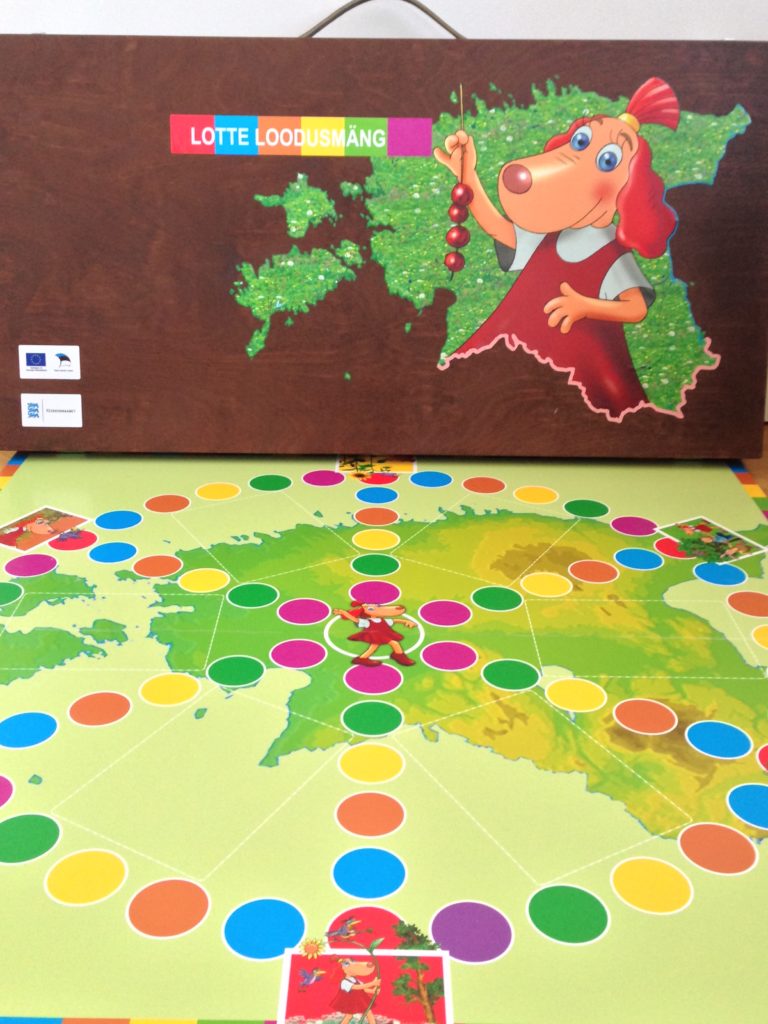
Lotte’s Nature Game. Click on the photo to view a larger image.
Peat Case – Exploring Bogs
Target audience: Grades 1–4; particularly suitable for grades 2–3
The “Peat Case” is a practical set of teaching materials that allows students to explore Estonian bogs, their biota, and natural phenomena even in the classroom.
The kit was created to make learning about bogs more engaging. Students can examine real specimens, make observations, and complete assignments.
What does the Peat Box contain?
- Herbarium specimens of the most common plant species growing in Estonian bogs.
- Peat samples in test tubes.
- Peat samples for examination with a magnifying glass or microscope.
- Teacher’s guide materials.
- Student worksheets.
- Additional sample materials needed for studying bogs.
The sample materials were collected from bogs in southern Estonia.
What do we learn with the Peat Box?
- What are the different types of bogs in Estonia?
- What plants and other organisms live in bogs?
- How is peat formed?
- What is the importance of bogs in nature?
- How can we study natural materials using practical observation tools?
This teaching resource supports the teaching of natural science, geography, and biology, and helps connect theoretical knowledge with hands-on research.
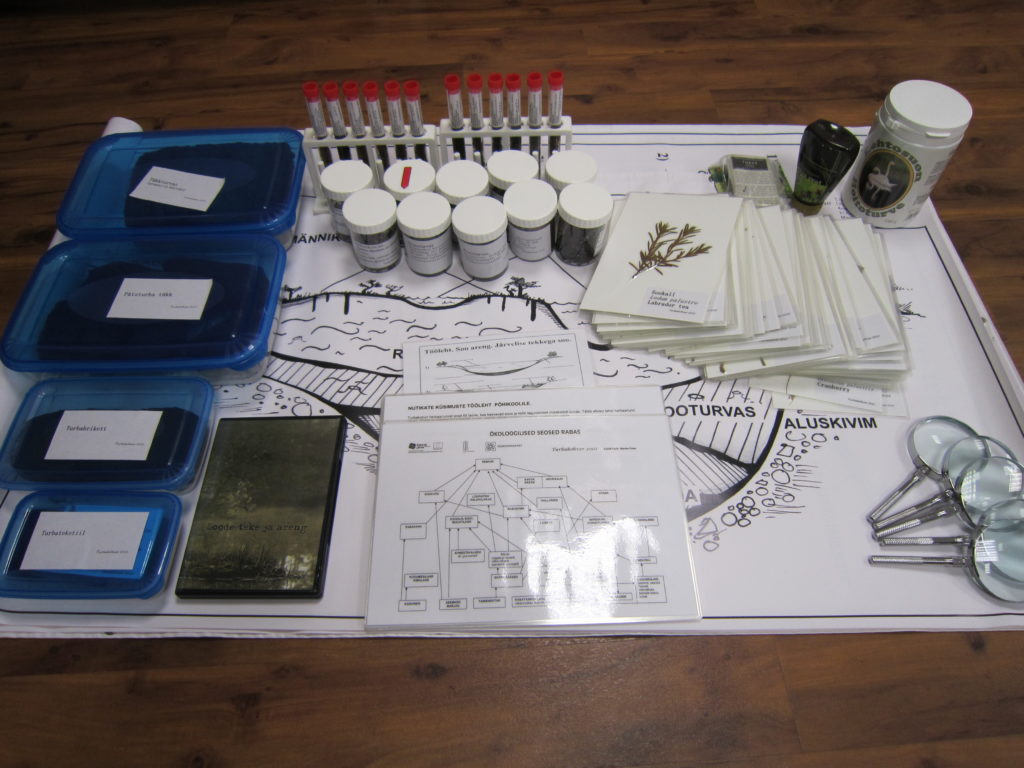
Contents of the peat kit. Click on the photo to enlarge it.
Background of the Educational Resource
The peat kit was developed as part of the Estonian-Latvian cooperation project “Back to Nature.” The project was supported by the European Regional Development Fund through the Estonia-Latvia program and the Environmental Investment Center Foundation.
The project partners were the Tartu Environmental Education Center Foundation, the Peipsi Cooperation Center NGO, and the Environmental Board from Estonia, as well as the Gauja National Park Foundation and the Ķemeri National Park Administration from Latvia.
The Coastal Meadow Kit – Life in a Grazed Meadow
Target audience: Grades 1–4
“Coastal Meadow Kit” is an educational resource designed to help students learn about coastal meadows, the organisms found there, and the impact of grazing.
The focus of the educational tool is livestock manure and its important role in the nutrient cycle and biota of meadow ecosystems. We explore how a diverse habitat develops in grazed meadows and how different species are interconnected.
What do we explore with the Coastal Meadow Kit?
- The biota of coastal meadows and their various habitats.
- The importance of grazing in preserving grasslands.
- The role of domestic animals in grassland ecosystems.
- Manure as a habitat and food source for many organisms.
- Natural processes occurring in meadows.
What teaching materials can be used?
The teaching kit includes practical supplies and multimedia materials, including short films and quizzes.
These help introduce meadow biodiversity even when classes are held indoors and observation opportunities in natural meadows are limited due to the season.
Although the examples are primarily from coastal meadows, the section of the kit covering domestic animals, grazing, and manure is also suitable for learning about other grazed meadow ecosystems.
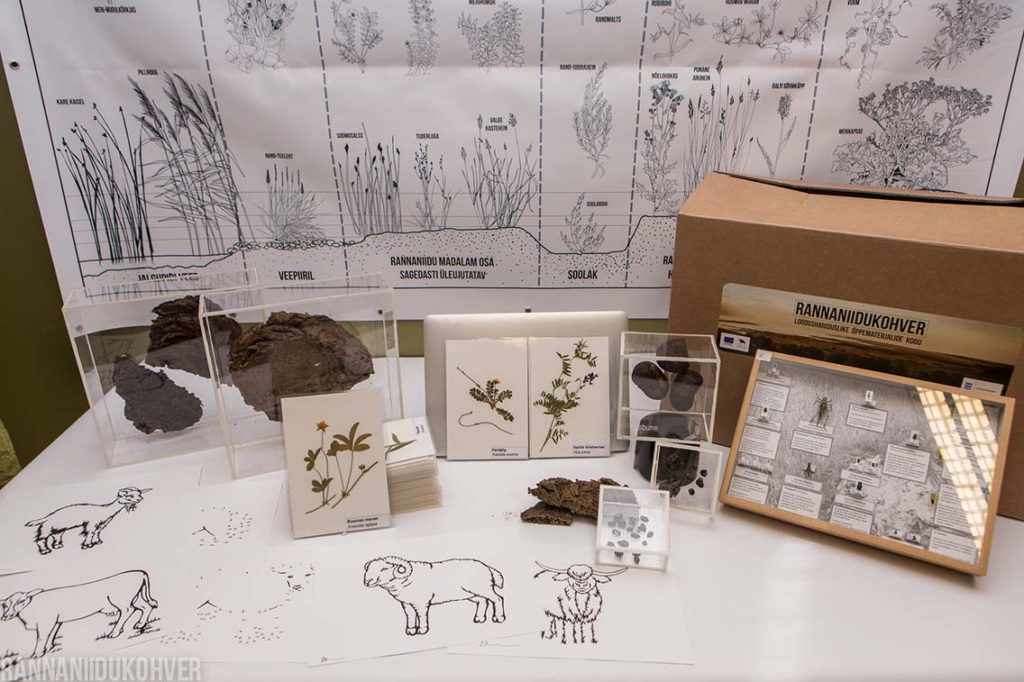
Coastal Meadow Kit teaching aid. Click on the photo to view a larger image.
Fair Trade – A Game-Based Learning Tool
Target audience: Grades 2–4
Where do bananas, coffee, cocoa, and cotton come from? Who grows them, and what are the social and environmental issues associated with their production?
The “Fair Trade” teaching resource helps students understand international trade relations, producers’ working conditions, and consumers’ opportunities to make more informed choices.
Four main topics
- Bananas: cultivation, production, and supply chains.
- Cotton: the origin of raw materials for textiles and the impact of production.
- Coffee: working conditions for growers and trade relations.
- Cocoa: social and environmental issues related to production.
How is the teaching resource used?
Students answer questions, discover new facts, and earn points as teams.
Points are tallied using the buttons on the built-in scoreboard, which are moved for correct answers.
After the question-and-answer round, the teacher can use the texts on the other side of the teaching aid to explore the background of each topic.
For example, we can discuss the challenges producers face and how fair trade principles aim to improve working conditions, support communities, and reduce environmental damage.
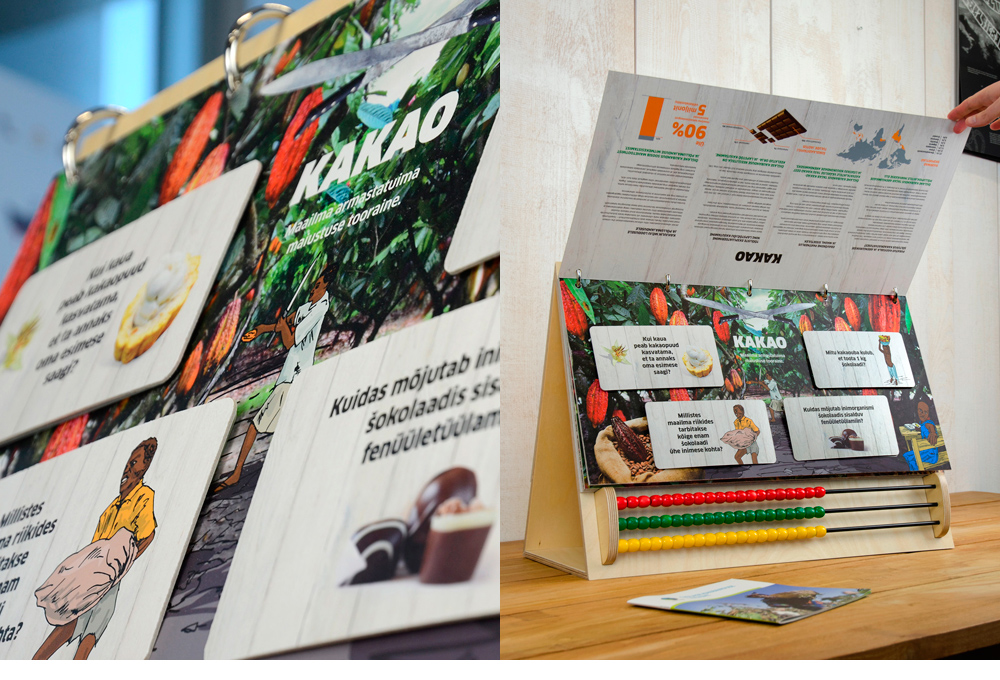
Fair Trade teaching resource. Click on the photo to view a larger version.
Where is life more sustainable and sensible?
Target audience: Grades 3–4
Which everyday choices have the greatest impact on the environment? Does our idea of an eco-friendly lifestyle always match reality?
The interactive learning tool “Where Is Life More Sustainable and Sensible?” helps students understand how different consumption habits and lifestyles affect the use of natural resources and the environment.
What topics do we cover?
- Home heating and thermal energy consumption.
- Transportation and daily modes of travel.
- Use of electrical appliances.
- Food production and consumption.
- Water use.
- Waste generation and management.
- The environmental impact of various services and consumption choices.
How does the game work?
The teaching aid consists of a magnetic board and cards that introduce the lifestyles and habits of four typical Estonian households.
Students learn about the families’ activities and assess how sustainable their daily choices are. They then award points to the families on the magnetic board.
An important part of the game is the discussion: students explain their assessments, listen to their classmates’ arguments, and compare different perspectives.
Students can compare their results with the assessments of the experts who helped develop the game. An explanatory booklet included in the kit provides additional support for the teacher.
What does the game teach?
The game helps students understand that environmentally friendly choices cannot always be assessed based on a single action. It is important to look at the big picture and consider which actions place the greatest strain on the environment and natural resources.
This educational tool promotes critical thinking, reasoning, and a more informed approach to everyday consumption choices.
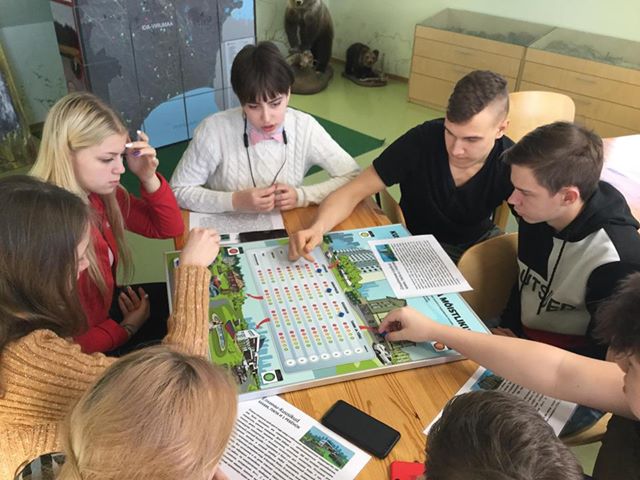
The Eco-Friendly Choices Game. Click on the photo to view a larger version.
How to borrow educational materials?
To borrow teaching materials, please contact the Tartu Nature House in advance. Let us know which teaching materials you’d like to borrow and for how long you’ll need them.
We’ll send you information about the availability of the educational materials, pickup and return procedures, and other practical details.
Rental fee: 10 € per week for a set of educational materials or a nature game.
Rental Contact
Email us the name of the desired educational resource, the rental period, the name of your organization, and your contact information.
See other rental options
In addition to educational materials, you can borrow traveling exhibits and larger outdoor games from the Tartu Nature House.